Post-Mining Sawahlunto: Lessons for Coal-Producing Regions Navigating The Transition
Zulfikar Aji Kusworo • Author
06 July 2026

60
• 5 Minutes Read
Post-Mining Sawahlunto: Lessons for Coal-Producing Regions Navigating The Transition
Image: Rhmtdns/Wikimedia
When the discourse on a just energy transition emerged in Indonesia, the conversation largely focused on emissions targets, renewable energy mixes, and international financing schemes. Far less attention was paid to the most fundamental question: what will happen to communities that have depended on coal for decades when the mines cease operations?
The city of Sawahlunto in West Sumatra holds the answer to that question, a real-life lesson that has been unfolding for more than two decades.

Entrance to the Ombilin coal mine, Sawahlunto. (Source: Collectie Tropenmuseum, Nationaal Museum van Wereldculturen [TMnr 20018524], via Wikimedia Commons).
Sawahlunto is a city built on coal. Since the late nineteenth century, during the Dutch colonial era, it has served as Indonesia's first major coal mining center. Mining operations were later managed by PT Bukit Asam (PTBA) until the early 2000s, when dwindling coal reserves led to the gradual closure of the mines.
The mine closure drastically changed Sawahlunto's economic landscape: local incomes plummeted, jobs disappeared, and young people left the city to seek a livelihood elsewhere. Population data shows a consistent decline in the town’s population following the closure of the mines, a strong indicator of the economic dislocation that occurred.

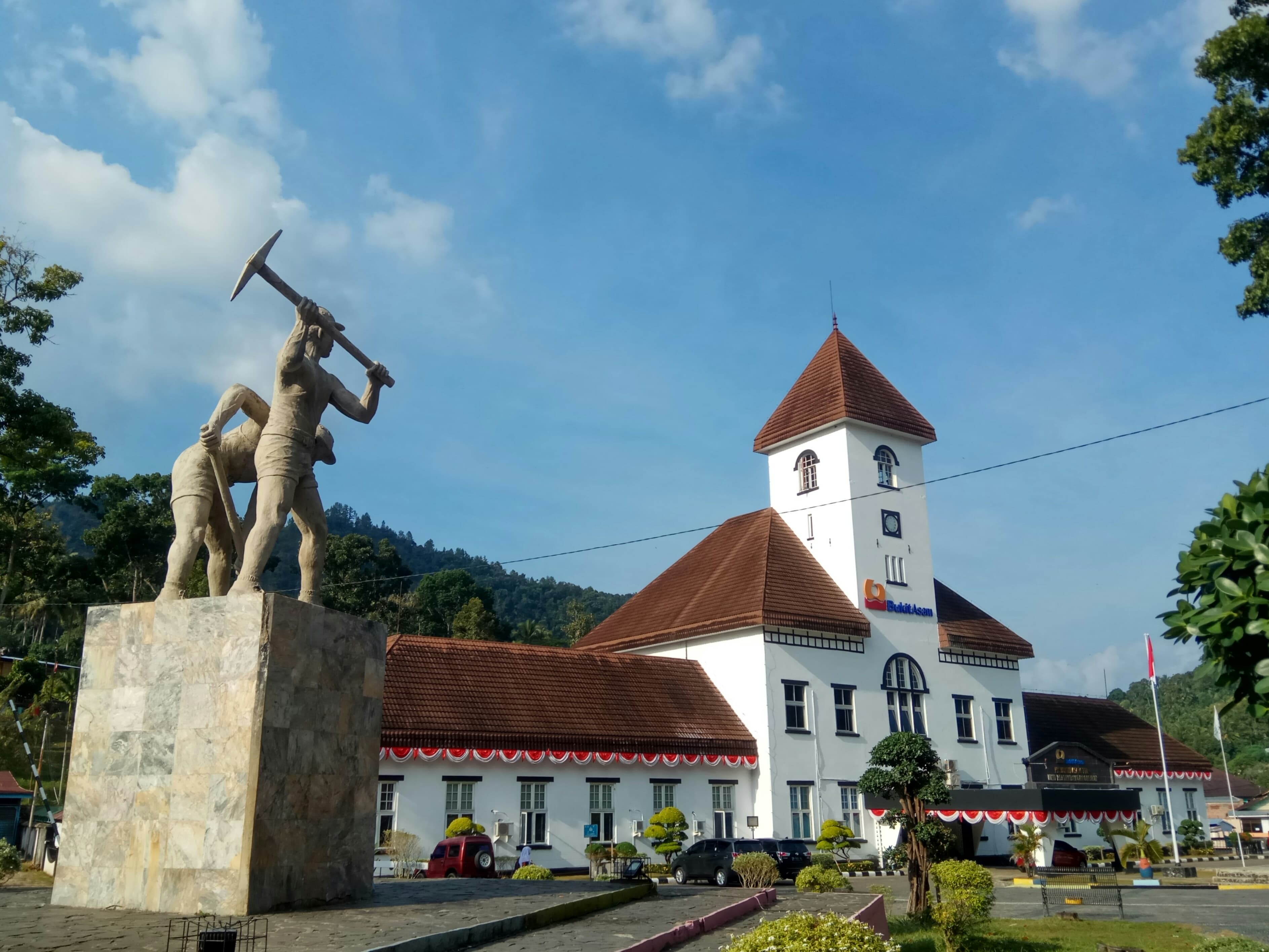
Indonesia's state-owned coal company, PT Bukit Asam, Sawahlunto (2019). (Source: https://sawahluntotourism.com via Wikimedia Commons)
A study by the SMERU Research Institute found that the impact of the mine closure in Sawahlunto was not felt evenly. Women, many of whom earn a living in the informal sector closely linked to mining activities, were among the most economically impacted.
These findings are consistent with the just transition framework, which emphasizes four dimensions: recognition of social impacts, compensation for affected parties, equitable distribution of benefits, and inclusive decision-making. Without comprehensive transition planning, mine closure has the potential to create new inequalities.
However, Sawahlunto also offers a narrative of hope. The city has successfully transformed its economy by turning its mining heritage into a tourism asset. In 2019, the Ombilin coal mining heritage site in Sawahlunto was designated a UNESCO World Heritage Site. The mine shafts, historic railway lines, and remaining colonial infrastructure have since been repurposed as attractions for domestic and international visitors.
This transformation didn't happen overnight. It took years, support from local government policies, and the active participation of local communities willing to redefine their city's identity beyond coal.

Museum Mbah Soero Mining Pit (Source: UNESCO World Heritage Centre).
Sawahlunto's experience is highly relevant given the current state of Indonesia's coal mining sector. By 2026, the government plans to cut the national coal production quota to around 600 million tons, down from the 790 million tons produced in 2025.
The 40-70% cut in the Work Plan and Budget (RKAB) has raised concerns about mass layoffs affecting 169,341 mining workers in East Kalimantan, most of whom are contract workers with subcontractors. In Kutai Kartanegara, a district heavily dependent on coal, the local government has publicly expressed concerns that the production cuts will weaken the regional economy.
At the national level, the energy transition is projected to result in the loss of 30,000 jobs in the mining sector between 2020 and 2040. This estimate does not take into account the ripple impacts on contractors, transportation companies, shipping companies, and other supporting industries whose businesses depend on coal production activities.
At the regional level, the decline in mining activity has also reduced non-tax state revenues (PNBP) and revenue-sharing funds, weakening local governments' fiscal capacity to finance infrastructure, education, and social programs. Without appropriate policy design, this will impact cash flow, particularly for small- and medium-scale mining.
What Can We Learn from 25 Years of Sawahlunto’s Transition?
First, post-mining economic transition takes far longer than a single term of government. Sawahlunto found its new economic identity after nearly two decades of struggle.
Regions like East Kalimantan, South Kalimantan, and South Sumatra should begin planning for the transition rather than waiting for the mines to close. Second, economic diversification must be rooted in local assets and potential. Sawahlunto has succeeded by leveraging its mining heritage to create tourism assets. Other regions need to identify their respective comparative advantages, whether in renewable energy, agriculture, or the service sector.
Third, social protection for affected workers should not be limited to severance pay but should include retraining programs that equip them with the skills needed in emerging industries. Technical skills such as systems design, construction, and maintenance of renewable energy projects are urgently needed as the development of clean energy infrastructure accelerates. Fourth, the transition process must actively involve affected communities in decision-making, including women and marginalized groups who are the most vulnerable but least heard.
With Indonesia's Just Energy Transition Partnership (JETP) funding commitment now reaching US$21.8 billion and a 100-gigawatt (GW) solar power program through the Merah Putih Village Cooperative, the momentum to design a just transition is within reach.
The Indonesian Environmental Forum (WALHI) reminds us that energy sovereignty must be built through a democratic process and based on regional potential. The just transition component of JETP must deliver tangible benefits to grassroots communities, not simply be a planning document.

Solar PV power plant in Sawahlunto to power farmers' irrigation pumps. Source: PT Bukit Asam (2023).
Sawahlunto has demonstrated that life after coal is possible, but it won't happen by itself. It requires careful planning, supportive policies, and, most importantly, a recognition that the energy transition is fundamentally a transformation of the way we live.
For hundreds of thousands of mine workers and millions of people living in coal-producing areas, the story of Sawahlunto is not just a story of the past, but a roadmap that must be read before it is too late.
---
Zulfikar Aji Kusworo is a researcher interested in renewable energy and energy transition. He completed his master's degree in energy systems at Gadjah Mada University (UGM).