Energy Projects: 81 Years of Independence, Yet Indigenous Peoples Still Fight for Their Land
Bram Setiawan • Author
17 August 2026

83
• 6 Minutes Read
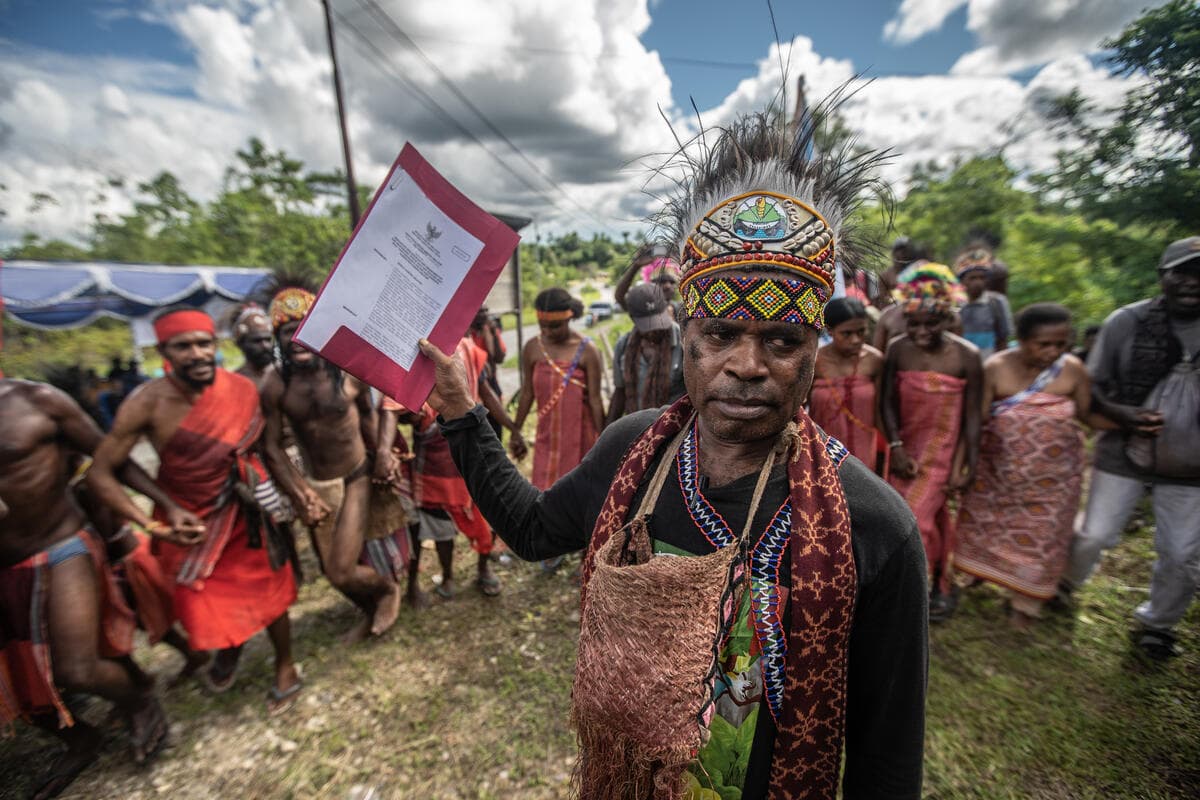
Image: Jurnasyanto Sukarno / Greenpeace
As Indonesia approaches its 81st anniversary and amidst President Prabowo Subianto’s ambitious agenda to achieve energy self-sufficiency, many Indigenous communities find their living spaces increasingly threatened by development pressures. While Indonesia certainly needs to achieve energy independence, it is far more important to ensure that decarbonization efforts and renewable energy development do not come at the expense of Indigenous communities' living spaces.
The Indigenous Peoples' Alliance of the Archipelago (AMAN) recorded 135 cases of customary land dispossession in Indonesia during 2025, affecting 3.8 million hectares of ancestral lands belonging to 109 communities. Energy projects are among the sectors involved in these dispossessions.
Just look at the various conflicts that have emerged, ranging from nickel mining in Raja Ampat and geothermal development in Poco Leok, East Nusa Tenggara, to energy crop plantations that encroach upon the ancestral lands of Indigenous communities in Bangka Belitung. These conflicts highlight the vulnerability of Indigenous rights protections within the development process.
1. The threat of nickel mining in Raja Ampat
Raja Ampat, dubbed the "last paradise on Earth," is not immune to the threat of nickel mining. In 2025, local Indigenous youth opposed nickel mining exploitation efforts on the islands of Manyaifun and Batang Pele. This opposition arose due to the risk of biodiversity loss facing the Indigenous communities in the villages of Manyaifun and Batang Pele.
Nickel is a raw material for stainless steel used in renewable energy infrastructure. It also serves as a raw material for electric vehicle batteries, which are currently in high demand in the global market.
According to a Greenpeace Indonesia report, Unprotected Paradise, three companies namely PT Raja Ampat Nikel Abadi, PT Waegeo Mineral Mining, and PT Eka Kurnia Baru, are currently seeking nickel mining permits for the eastern part of Waigeo Island. The expansion of mining access in this area threatens the livelihoods of the Maya, Matbat, and Biak indigenous communities, who have long relied on the sea and its biodiversity for their survival.
For some time, these three indigenous communities have practiced traditional marine management systems to regulate fishing activities, protect coral reefs, and ensure the long-term availability of resources. Furthermore, Raja Ampat Regent Regulation No. 8 of 2017 mandates the protection of fish, marine biota, and other natural resource assets within the coastal and marine areas that fall under the customary territory of the Maya people.
2. Poco Leok residents oppose geothermal project
In Poco Leok, Manggarai, East Nusa Tenggara (NTT), tensions have arisen due to geothermal energy development. Local indigenous communities oppose the expansion of the Ulumbu Geothermal Power Plant (Units V–VI) as the project threatens their customary lands, water sources, and agricultural areas, as well as their socio-cultural fabric.
Opposition efforts were also pursued through legal channels. On March 10, 2026, the Kupang Administrative Court ruled in favor of Poco Leok residents in their lawsuit against the Regent of Manggarai regarding actions that obstructed protests against the Ulumbu Geothermal Power Plant (PLTP) Units V–VI project. Although the victory did not result in the cancellation of the project, the court declared the Regent's actions unlawful.
The low-carbon energy project in Poco Leok demonstrates that the rights of Indigenous communities to their ancestral lands and living spaces cannot simply be disregarded. The issue goes beyond mere renewable energy development; it concerns how the state ensures community participation and freedom throughout the development process. The Poco Leok customary territory, as recorded by the Indigenous Territory Registration Agency (BRWA), encompasses ten Indigenous communities (*gendang*) that have documented their customary lands and living spaces.
Geothermal project development began to intersect with Indigenous communities after the Regent of Manggarai designated Poco Leok as the project site on December 1, 2022. In August 2023, approximately 500 residents from ten traditional villages (*gendang*) staged a protest against the Ulumbu geothermal power plant project. The opposition persisted, and on June 5, 2025, residents faced intimidation while protesting. That incident subsequently formed the basis of a lawsuit filed with the Kupang Administrative Court on September 3, 2025.
3. Squizzed by energy plantations in Bangka Belitung
In Bangka Belitung, the development of Energy Plantation Forests (HTE) to produce fuel for coal co-firing not only alters the function of areas previously designated as Industrial Plantation Forests (HTI) but also threatens remaining natural forests. Forest Watch Indonesia (FWI) has recorded the loss of 2,758 hectares of natural forest between 2017 and 2021, alongside an additional 4,332 hectares of natural forest within HTE concessions that remain at risk of deforestation.
This threat extends into the territories inhabited by Indigenous communities. As the shift from Industrial Forest Plantations (HTI) to Energy Forest Plantations (HTE) is promoted, Indigenous communities face the risk of land-use changes that further encroach upon their living spaces. A clear example is the territory inhabited by the Mapur people; rather than being recognized by the state as customary forest, it has been designated as production forest, with the majority of concession permits held by oil palm plantations and HTI companies. Many of these HTI concessions encompass areas considered sacred forests by the Mapur community, such as the forests of Mount Cundong, Kasak Tade, and Bukit Tabun.
Similarly, the living space of the Jerieng community in West Bangka Regency is increasingly squeezed between oil palm plantations and Industrial Forest Plantations (HTI). Since 2017, the community alongside the Indonesian Forum for the Environment (Walhi) of the Bangka Belitung Islands has persistently urged the revocation of the HTI permit held by PT Bangun Rimba Sejahtera, which covers an area of 66,460 hectares across 39 villages. Community opposition continues to be voiced through various hearings held at the Bangka Belitung Islands Governor's office.
Low-carbon is not enough
These three stories involving Indigenous communities demonstrate that the government must ensure energy projects and their supply chains adhere to principles of participation, access to comprehensive information, the protection of Indigenous territories, and the consent of Indigenous communities.
The government also needs to accelerate the recognition of customary territories before planning projects in a given area. In this way, the energy transition aims not only to meet low-carbon targets but also to ensure that the communities involved in this agenda do not lose the right to determine the future of their living spaces.
Renewable energy development should not be viewed solely as an infrastructure project. If indigenous communities wish to meet their energy needs independently and sustainably, the government needs to support these efforts. Indigenous communities can also be fully involved in the planning, implementation, and management stages. In this way, the government need not rely exclusively on large-scale energy projects, which tend to carry higher risks regarding social conflict, land disputes, and the loss of biodiversity.