Two Burdens, One Body: How Dieng’s Geothermal Project Falls Hardest on Women
Dini Suryani • Author
08 June 2026

338
• 7 Minutes Read
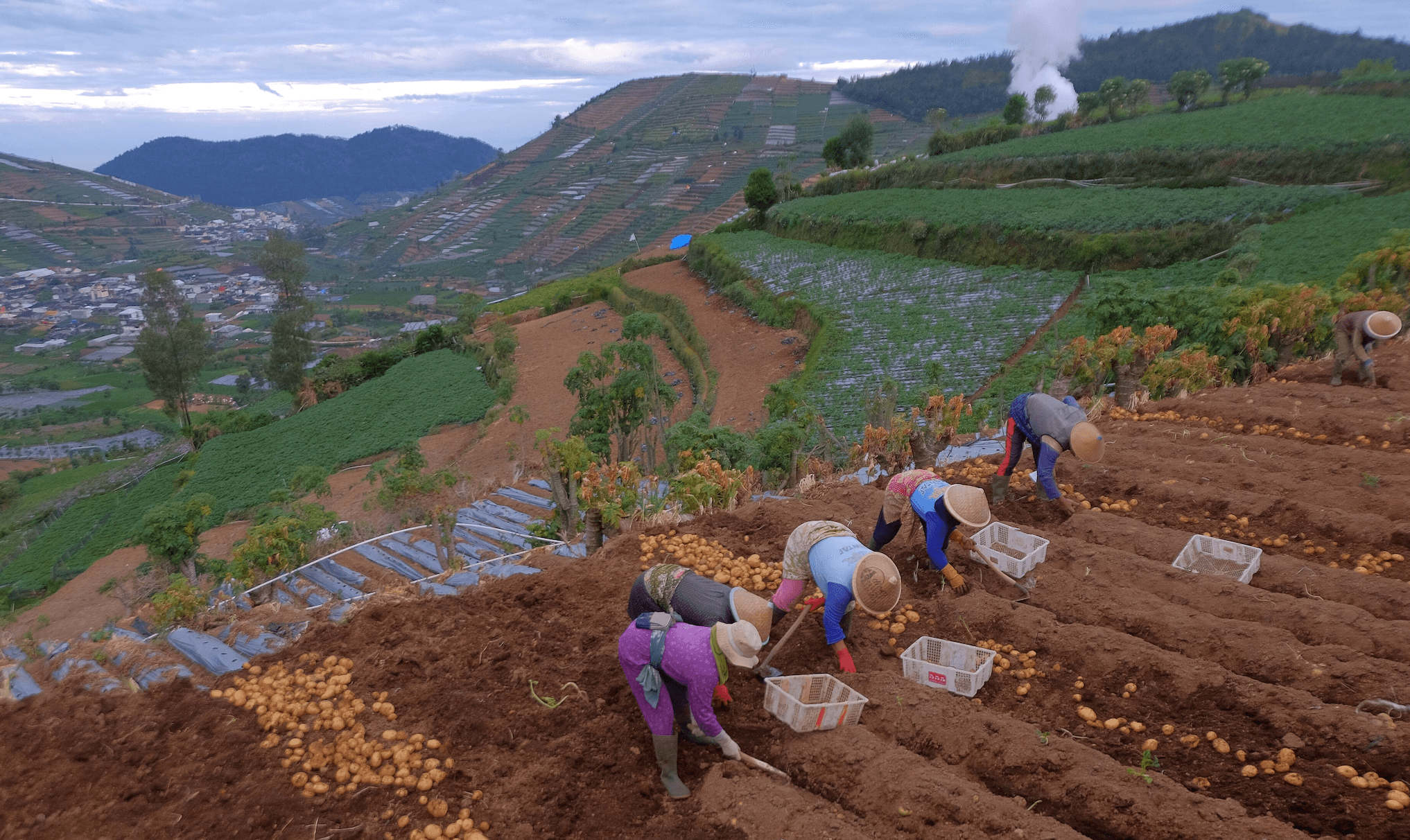
Image credit: Arief1802/Wikimedia Commons
"Even when brewed as tea, it doesn’t taste good," said Surti (not a real name), a resident of Kepakisan Village, Banjarnegara Regency, Central Java. She was describing the water contaminated by the geothermal project in the Dieng Plateau.
When the author and the research team visited her house, we were greeted with eight glasses of water served on two trays. On one tray was some water from the Pawuhan spring and the other from the Mount Prau spring.
We tasted it and we all had a strange aftertaste. The water from the Pawuhan spring left a strange aftertaste in our mouths, unlike the water from Prau, which was relatively tasteless.
According to Surti and other local residents, the Pawuhan spring has long been polluted by the geothermal project in the Dieng Plateau, Central Java, especially the Dieng Unit 1 Geothermal Power Plant (PLTP) which was established in 2001.
In 2022, when construction of the Dieng Unit 2 Geothermal Power Plant (PLTP) began, many local residents opposed the project. This opposition stemmed from air pollution experienced by residents from previous projects and concerns about potential explosions.
This article aims to highlight the other side of green energy, which looks promising on paper but carries an unequal burden, particularly on women.
Geothermal Energy in Dieng
The geothermal project in the region, known as the "Land Above the Clouds," has been underway since 1970 through a program funded by the United States Agency for International Development (USAID) and the French Bureau of Industrial Development (BEICIP). After being managed by Pertamina from 1977 to 1994, and developed by Himpurna California Energy Ltd. from the United States from 1995 to 1998, the geothermal project was returned to Indonesia and jointly managed by Pertamina and PLN in 2001.
In 2002, the two state-owned companies established PT Geo Dipa Energi (GDE) to manage geothermal wells in Dieng, Central Java and in Patuha, West Java. That same year, the Dieng Unit 1 project was built, consisting of seven production wells and eight injection wells with a capacity of 60 megawatts (MW).
In 2020, Geo Dipa signed an agreement with the Asian Development Bank to build the Dieng Unit 2 Geothermal Power Plant (PLTP) for a duration of 10 years until 2030 with a target of 55 MW of electricity from 10 wells. The government also showed its support by designating the Dieng Unit 2 Geothermal Power Plant as a National Strategic Project (PSN) to support the energy transition agenda that encourages the use of renewable and sustainable energy. In short, the Dieng Geothermal Power Plant is a significant contributor to achieving the National Energy General Plan (RUEN) that targets 7.24 GW by 2025 and 17.55 GW by 2050 for geothermal energy.
Although its position is still far behind solar and hydropower, the government, through a statement by President Prabowo Subianto, still views geothermal energy as a vital renewable energy source for Indonesia. This is especially true given Indonesia's substantial geothermal reserves, accounting for 40% of the global geothermal potential.
Negative Impacts of Geothermal Energy
However, behind these figures lie the negative impacts experienced by residents surrounding the geothermal project site. As stated earlier in this article, water is the most severely affected resource by the Dieng geothermal project. The geothermal extraction process carries the risk of groundwater contamination due to its high mineral content. Therefore, the water previously consumed by residents now tastes salty and contains cement-like residue, as experienced by Ibu Surti's family and other residents of Kepakisan Village.
As a result, they had to find other water sources farther from their houses. The community then worked together to install water pipes at a shared cost.
A study by the Centre for Human Rights Studies at the Islamic University of Indonesia (Pusham UII) also revealed that water pollution affects not only household activities but also agricultural activities. Dieng farmers in Bitingan Village, some of whom are women, experienced a decline in potato productivity, a major crop in the area, due to the unsafe water used for irrigation.
Through its corporate social responsibility (CSR) program, the company has provided assistance in the form of water wells. However, according to farmers, the wells cannot be used to draw water for the electricity costs they must bear.
In addition to water issues, the tourism industry is also impacted by the crisscrossing pipelines in the Dieng region. In the Sikunir area, we spoke with Ibu Mia (also not a real name), a homestay owner whose access is blocked by the geothermal pipes. Although a bridge over the pipeline has been built to reach her homestay, this doesn’t stop her from complaining about the geothermal pipes being so close - even intertwined - with residential areas.
Some of the pipes are also hot, making them extremely dangerous if touched by children playing nearby. To some extent, this has affected her homestay business. Women in Dieng are one of the key players in the local tourism industry, both as producers of souvenirs and as homestay operators. Geothermal infrastructure has disrupted this role.
The study by the UII Centre for Human Rights also noted other disruptions, such as the noise made during well testing, which could last up to seven days and seven nights. Residents, particularly children, had difficulty sleeping, and women who mostly serve as the primary caregivers face the additional burden of soothing their children, thereby reducing their own rest time.
Geothermal and Its Burden on Women
Although women are significantly impacted by energy transition projects, this group is often excluded from decision-making processes. In fact, they experience increased burdens, such as having to consider the availability of clean water for consumption and agriculture, the safety of running businesses, and the increased mental burden of childcare.
In discussions between the author and the research team with Geo Dipa, women were only positioned as objects (beneficiaries), particularly within the company's CSR scheme. Women were not positioned as sources of information of the impacts they experienced. However, community leaders we met in Dieng told us that the geothermal project's National Strategic Project (PSN) status in the region meant that residents' opinions were generally not heard. In fact, the Dieng Unit 2 Geothermal Power Plant is run on the basis of a financial loan from the ADB which requires a mechanism for participation and protection of affected communities, including those with a gender perspective in the projects it funds. However, these mechanisms have not yet substantively addressed women's groups.
The issue of geothermal energy and its impact on women can be understood through the lens of feminist political ecology. This perspective observes that environmental changes have unequal impacts, as they are linked to who has access to natural resources, who manages them, and who bears the consequences.
In the rural context of Dieng, in particular, women are the frontliners of water management, food management, childcare, and, in some cases, household finances, making them vulnerable to environmental degradation. A study of the impacts of a geothermal project in Padarincang, West Java, also revealed a similar pattern, which even led to resistance from women's groups.
Ibu Surti and the other women in Dieng will continue playing their roles in managing water and food, raising children, and supporting their households financially. And as long as the geothermal project continues without addressing their needs and those of other affected residents, women will continue to bear this additional burden.
The energy transition should not merely be about replacing fossil fuels with renewables. It should require meaningful participation mechanisms that reach all affected groups, including women, so that “equity” is not just a slogan.
-
Dini Suryani is a researcher at the Political Research Center of the National Research and Innovation Agency (BRIN). Dini extended her gratitude to the “Exploring Materiality of Energy Justice” Research Team: Yogi Setya Permana (BRIN Political Research Center); Hasrul Hanif (Gadjah Mada University); and Laila K. Alfirdaus (Diponegoro University), who collaborated on researching the impact of geothermal energy development in Dieng, Central Java, some of whose data served as the basis for this article. The author also wishes to thank the BRIN Social Sciences and Humanities Organization of BRIN for the research funding through the Research for Collaborations Rumah Program OR IPSH BRIN 2025 program.