Utilizing Reclaimed Land for Solar Energy Farms: What's the Potential?
Bram Setiawan • Author
06 October 2026

31
• 6 Minutes Read
Solar energy is one of the quickest and easiest options for increasing power generation in many countries. The methods for providing this additional renewable energy generation vary widely.
In Japan, a former golf course, popular in the 1980s, will be converted into a solar power plant (PLTS) area. China is utilizing former coal mines. In Singapore,the location of the Semakau landfill, the still-functioning Semakau landfill will also be used for a solar farm.
In Indonesia, the choices are even more diverse, and you don't have to use reclaimed land.
1. Former golf course in Japan
Minohara Country Club, a golf course in Gunma Prefecture will be converted into a solar power plant. In 2025, the loss-making golf course was purchased by Kamisato Kensetsu, a local construction and property company.The company plans to install 152 megawatts (MW) of solar panels there, making it one of the largest solar energy projects in Japan.
Golf courses began to emerge in Japan four decades ago. Many golf courses flourished along with the economic success of the Land of the Rising Sun. However, the popularity of golf has steadily declined,particularly in rural areas where the population is shrinking. Kamisato Kensetsu aims to close Minohara Country Club by 2030, when construction of the solar power project begins.
The use of former golf courses is also driven by Japan's densely populated and mountainous terrain, making it difficult for developers to find sufficiently large locations. Today, the legacy of Japan's economic bubble is useful in the energy transition. Many golf courses have characteristics suitable for solar power plants, such as sunlight exposure, access to the electricity grid, and proximity to residential areas.
2. Former coal mine in China
In China, former coal mining areas are being repurposed for solar power plants. Besides providing space for power plants, this redevelopment provides a new function in areas that have been transformed by mining activities.
China has 90 projects in operation that convert former coal mines into solar power sites, with a total capacity of 14 gigawatts (GW), according to a report by Global Energy Monitor. (GEM). China is also preparing 46 additional projects of this kind, with a potential capacity of 9 GW.
Globally, more than 6,000 coal mines have been closed since 2010, the majority of which are in China. GEM highlights abandoned mining sites as an opportunity to deploy solar power plants and provide a new use for areas transformed by mining activities.
Di Datong, Shanxi, about 1,687 square kilometers of land has experienced land subsidence due to long-term, large-scale coal mining activities. Prior to development, the area was uninhabitable and unsuitable for industrial use.
In September 2015, construction of the solar power plant began with a capacity of 1.5 million kilowatts. The first phase covered approximately 3,307 hectares with a capacity of 1 million kilowatts. By the end of April 2024, the plant was generating 12.67 billion kilowatt-hours (kWh) of electricity. Various plants also grow beneath the solar panels as part of a post-mining environmental restoration model.
3. Repurposing landfills in Singapore
In Singapore, the solar power plant project is not located on a former industrial site, but on the still-functioning Semakau landfill. The solar power plant is planned to have a capacity of 72 megawatts-peak (MWp), enough to generate electricity for approximately 17,500 households.
The planned solar farm will cover an area equivalent to 112 football fields. Semakau island was opened as a landfill on April 1, 1999. The 350-hectare area is estimated to be able to meet the country's waste disposal needs until 2035.
In 2025, Singapore achieved an installed solar energy capacity of 2 GWp. The Singaporean government aims to further boost solar energy, having raised its target to 3 gigawatt-peak (GWp) by 2030. This target includes utilizing rooftops, land, and water spaces. Other plans to achieve this target include installing overhang solar panels, which can serve as shelters, canopies in open-air parking lots, and other suitable areas.
What is the potential in Indonesia?
Indonesia has a wide range of potential sites for solar power development, including residential and commercial rooftops, agrivoltaic systems, former mining areas, and floating solar installations. Rooftop solar could supply 7–19% of Indonesia’s energy capacity needs by 2050. This potential is particularly significant given Indonesia’s commitment to industrial decarbonization by 2050.
Indonesia could also deploy solar power plants (PLTS) in former mining areas, as in China. There are approximately 2,300 square kilometers of post-mining areas in the country, which could accommodate around 0.5 terawatts (TW) of solar panels, equivalent to 7% of the country's energy demand.
Furthermore, Indonesia can continue developing floating PLTS by utilizing reservoirs or lakes. With a 5% utilization limit for freshwater, the area suitable for solar panels reaches approximately 2,500 square kilometers. At sea, areas suitable for solar power installations are those with a maximum wave height of four meters and a maximum wind speed of 15 meters per second. Indonesia has 700,000 square kilometers of this type of marine area.
Another option is agrivoltaics, which combines solar power installations with agricultural land growing low-lying crops such as rice, corn, tea, coffee, and tomatoes. There is approximately 210,000 square kilometers of potential land use. Further research into agrivoltaics is therefore needed to ensure that renewable energy production and conservation can go hand in hand.
These various options do not necessarily mean that solar energy is accessible to everyone. Even the most common models, such as rooftop solar power plants, lack regulations that ensure equitable access to ownership. Thus far, such systems remain within reach only for those with sufficient financial means, while low-income groups remain excluded due to the high cost of investment.
Furthermore, the Ministry of Energy and Mineral Resources (ESDM) issued Regulation Number 2 of 2024, which eliminates the net metering scheme for electricity sales to the state-owned electricity company, PLN. With the removal of this scheme, the economic incentives for installing rooftop solar power systems have diminished.
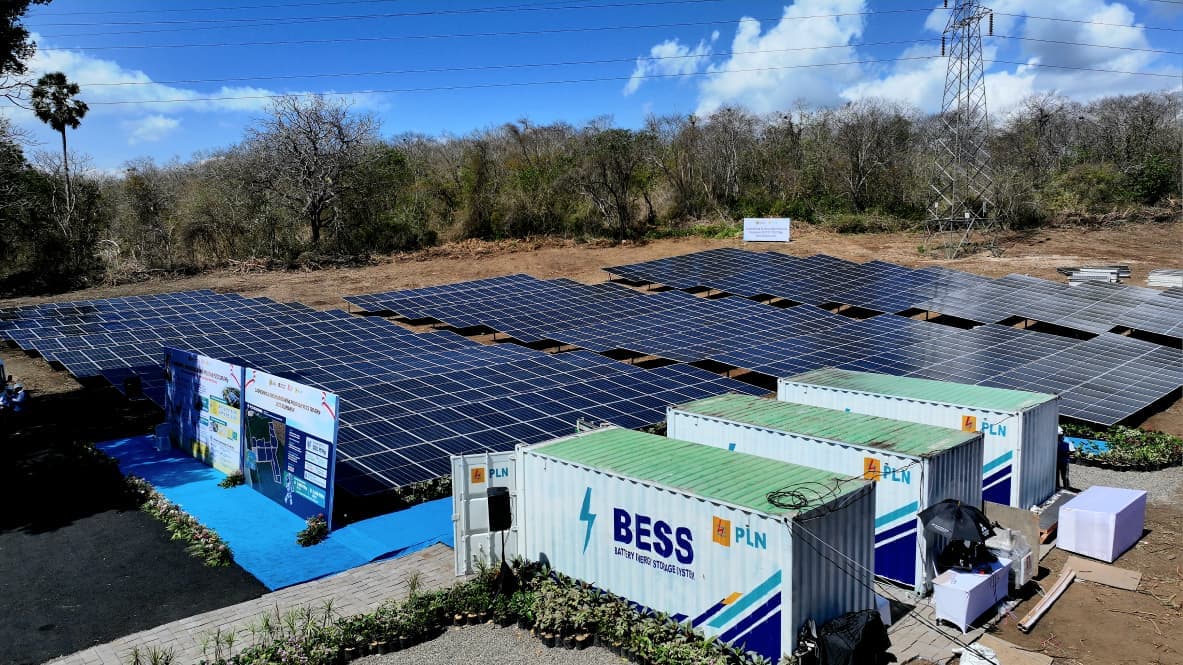
Supportive policies are therefore crucial for expanding public access to solar energy, even down to the household level through rooftop solar power plants (PV). Furthermore, solar energy can be developed through stand-alone PV systems equipped with battery energy storage systems (BESS) in remote areas.